

Transitioning into aged care
First published: November 2023
A non clinical perspective
With the aged care industry being a part of the healthcare space, the common perception is that you need a nursing qualification to be eligible for a role in a residential aged care home. This is true for a large number of job positions, as clinical members of the team are key contributors to the care of residents. Home management isn’t necessarily one of those. For a home to be successful, a facility manager and a care manager would usually work in unison.
Choosing a career in aged care
Altering your career path can be a daunting experience, but one that shouldn’t be disregarded if the right opportunity arises. A perfect example of how successful this can be is Prem Kainikkara, facility manager for Bolton Clarke Banora Point. Prem’s background consists of 26 years in the hospitality industry, managing international hotel chains and cruise ship businesses. His role consisted of overseeing the entire operation, from revenue, profit & loss, and cost, to guest satisfaction and experience and the implementation of policies and procedures across various locations around the world. Prem entered the aged care sector in 2021 after the covid 19 pandemic saw him stationary on a cruise ship located off the coast of New York for 9 months.
Q. How did you get into aged care and what was the thought process behind the change?
A. After the pandemic and not being able to leave the cruise ship for an extended period, I wanted to reunite with my family in Australia and find a role that would suit  my lifestyle. I wanted a role that would allow me to spend more time with my wife and daughter. I was recommended to apply to aged care homes because of my experience, so I decided to take it upon myself to contact organizations and seek out new opportunities. I landed a role at Opal Healthcare in 2021 and that commenced my aged care journey.
Q. What parallels can you draw between hospitality and aged care?
A. Both industries involve giving the best possible satisfaction to your clients and ensuring overall contentment. The hospitality industry, from my experience, sees you providing a service to a much larger community over a shorter time scale. With aged care, you get to know your residents on a much deeper level, which includes getting to know their families, history, needs, and wishes. With hotels and cruise ships, they may stay for a few nights or slightly longer, but with aged care not very often do the residents go in and then move back in with their respected family members.
Q. What transferable skills did you take with you and what does the role require?
A. General management is very similar. When it comes to overseeing operations in any capacity, you need to have the right business acumen, a total understanding of financial management, and a basic philosophy of finance. There is always an element of managing costs and assessing profit & loss. Marketing is a big part of a manager’s role as well. Going from hospitality to aged care, the most rewarding aspect for me has been the care of the residents. They are the heart and soul of any aged care home, and treating them with dignity and respect and, making sure they are always comfortable is your priority. This is their twilight years, and your job is to make it as memorable as possible. The satisfaction I have gained from 2 years in aged care supersedes the 26 years I spent in the hospitality industry. 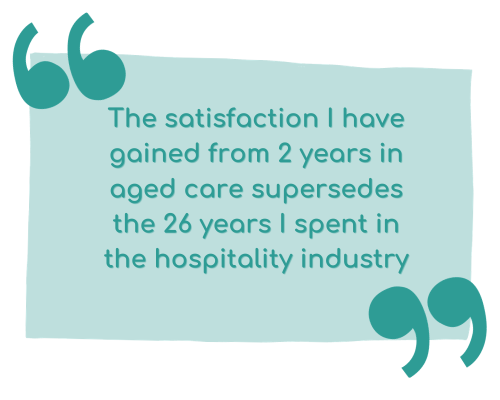
Q. How do you ensure resident happiness and success everyday?
A. Always put the residents first. It’s their home, ask them what they want. You and your team may have a great idea but if the residents don’t react to it very well, it won’t work. Being transparent and sharing information with residents and family is paramount. Clarity around communication, actions, and maintaining a collaborative approach is the key to creating a happy environment.
Q. The holiday season is approaching, how do you celebrate in the home and make sure it’s culturally diverse?
A. Make it as homely as possible. Any festivity, regardless of the reason you are celebrating comes with creating the right ambience and environment. Having everybody involved in the process ensures we can tailor any activities to the residents and to what they want to happen. Food is a big part of celebrations, and just like the meals we serve every day, we decide what to serve based on residents’ requirements, and requests, and whether it will enhance the residents’ experience. Regular food menus are devised through collaboration with chefs and will be adjusted depending on asking yourself what you would want if you were a resident here.
Q. How do you keep your day-to-day activities exciting and engaging to all residents?
A. Again, it all comes back to tailoring it to those who are going to experience it. Ask them what they want and devise plans from there. Certain activities will always be successful, but it always requires input from the residents. Remembering the demographics of the home will assist you in deciding what to do, and ensuring it is always inclusive for all is crucial.
Q. What were your main challenges transitioning into aged care?
A. Learning and tuning yourself into the compliance and legislation side of the business. It’s always a changing and ongoing process, so you need to constantly learn and adapt to new processes. It requires focus and a lot of learning. Being someone who welcomes change is a necessity for the role.
Q. If someone is looking to transition into the industry, what advice would you give them?
A. Your passion and commitment are what drive you every day. Resident care and making a difference in their lives is the real job of a manager. The smallest things make the biggest difference and remember that you are privileged to be in their home. I ask my team and residents to call me Prem – my job title is used for formalities only. It was like my time on the cruise ships, I referred to my coworkers as my team instead of crew or staff. Humanising yourself and developing friendships and trust is the way I like to lead my home. You are part of their life and family, so you need to be empathetic and remain compassionate. I am always the biggest advocate for my residents, and I wouldn’t change my career now.
At Sanctuary, we hire on a permanent, temporary, and contract basis, for both clinical and non-clinical roles. Start your new career in aged care today, and our experienced consultants can guide you through the process and provide everything you need to know. If you are considering a role in aged care, prepare your answers to commonly asked interview questions.
If you are open to opportunities, would like a confidential career discussion, or to find out about what we have available please call 02 8459 8101 or get in touch below

Register with us
Looking for a new opportunity
in the aged care sector?

Expert staffing solutions
Need staffing support on a temporary, contract or permanent basis?