
A guide to the Aged Care Funding Instrument (ACFI) and AN-ACC
First published: Demember 2024
For those receiving aged care services in residential aged care homes, the Aged Care Funding Instrument (ACFI) was used by the Australian Government to allocate subsidy amounts of residential aged care providers. Payments were based on the ongoing needs of residents and included a variety of factors such as activities of daily living, behaviour and complex health care.
This model was used until the 1st of October 2022, when it was replaced by the Australian National Aged Care Classification (AN-ACC).
Determining the needs of residents in an ACFI aged care assessment
When submitting a claim to the government, a provider would need to find out about a resident need from every angle, approaching from a holistic viewpoint. Their assessment can be broken down into three categories:
Activities of Daily Living (ADLs)
Whilst working in aged care, residents will present with a multitude of different needs that can by physical, emotional and social in nature. Examples of ADLS are helping a resident with:
- Grooming and personal hygiene
- Toileting and continence
- Meal rounds and feeding, with nutrition plans
- Mobility
The scale on which a resident will need to have assistance with the above tasks greatly varies from person to person. Submitting an accurate report to ACFI on each resident in the providers care aides to the decision on how much funding to provide.
Behaviour
A resident’s behaviour can exhibit signs demonstrating where more specialised care is needed. This is not only to keep the resident safe, but to ensure that their needs are consistently being met and to address the wellbeing of said resident and those around them.
Complex health care and medication management
More complicated health conditions will require additional treatment and management. This may come down to medication and care planning, but also time spent from registered nurses with that resident. If a resident needs to take medication regularly, then determining whether they can take it alone or need assistance and supervision in doing so is important in deciding the funding that ACFI provides.
How to submit an ACFI claim
Residential aged care providers can still make an ACFI claim for any resident in their care up to the 30th of September 2022. This can be done online at Services Australia, or through a paper-based form submission via post.
You will be able to successfully receive ACFI payments if you completed the ACFI application for the resident at least 7 days after they entered your care, or before the resident had been with you for two months. Penalties apply for late submissions.
Changes to the ACFI model
The aged care reform roadmap from 2022 – 2025 was put in place in response to the Royal Commission into Aged Care Quality and Safety investigation into the aged care system, giving 148 recommendations of change for better aged care delivery. Investigations into the ACFI model found that it wasn’t as effective as it could be. It was deemed to be outdated, and not fulfilling the needs of residents in aged care, especially those receiving complex care. Relevant recommendations that apply to funding are:
- Recommendation 41: Planning based on need, not rationed. This advised that funding allocation needs to be sufficient to meet people’s entitlements for their assessed needs.
- Recommendation 112: Immediate changes to the ‘Basic Daily Fee’, which increased by $10 per resident per day.
- Recommendation 120: Casemix-adjusted activity-based funding in residential aged care. This suggests using the AN-ACC model for higher quality care.
Based on these recommendations and with the aim to provide equitable funding to approved providers, the AN-ACC funding model replaced ACFI. The goal here is to deliver high quality resident care with appropriate finances.
How AN-ACC works
After an AN-ACC assessment, a resident will be assigned a class, which helps to allocate part of the funding the provider receives to carry out their activities of daily living. The total subsidy an aged care provider gets is determined in a three-component system:
- Basic Care Tarriff – a fixed amount which looks at the home’s location and consideration for homelessness and Aboriginal and Torres Strait Islander peoples.
- The resident’s AN-ACC classification
- Initial adjustments which are based on any transitions of a permanent resident into the particular service.
The AN-ACC Classification System
Differing from ACFI, AN-ACC focuses heavily on 13 classes to properly assess each residents needs. The system used is broken down below:
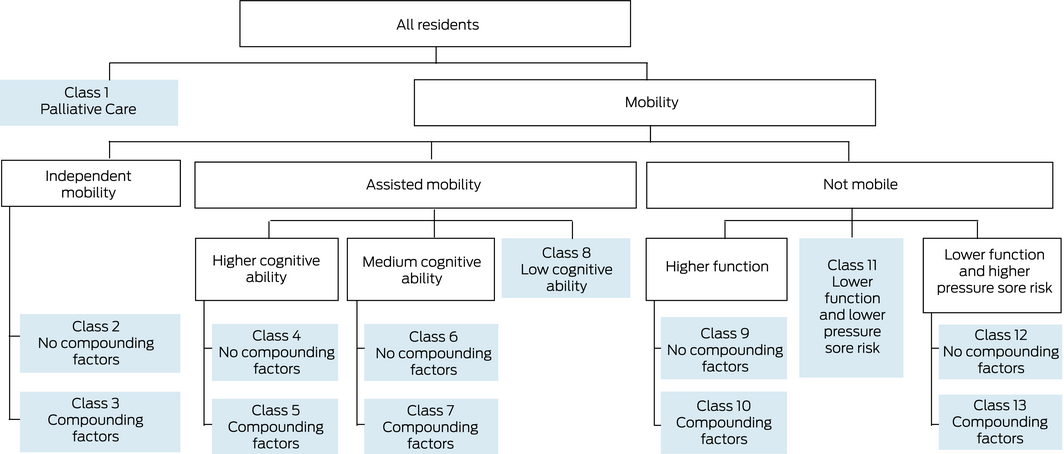
Source: The Medical Journal of Australia
The benefit to this new system is that more time is spent to accurately evaluate each resident, making sure that there is adequate funding to tend to their needs on every level. The Aged Care Quality and Safety Commission created 8 Aged Care Quality Standards that define standards for safety and quality in the industry. Ensuring that these are met can be done through AN-ACC.
Aged care residents receiving palliative care
Another facet to AN-ACC, improving on the ACFI model, is the specialised path for those who require palliative care. Those who this applies too will not need an assessment, unlike every other resident entering aged care, and they will be placed into the class 1 funding bracket.
Further information on AN-ACC and aged care services
To learn about AN-ACC in more detail, visit the Australian National Aged Care Classification website.
Want to learn more about our aged care recruitment services? Contact our friendly team today:

Register with us
Looking for a new opportunity
in the aged care sector?

Expert staffing solutions
Need staffing support on a temporary, contract or permanent basis?